

As a roofing professional with over 15 years of experience in Southern California, I know the sense of unease that settles in as summer peaks. Here in Beverly Hills, August isn't just about the heat; it's about the wind. When the Santa Anas start to blow, they carry an invisible threat: a blizzard of tiny, superheated embers that can travel for miles. These embers are the primary cause of home ignition during a wildfire, and your roof is their main target. They don't just land on top; they are driven by fierce winds into the smallest, most overlooked gaps in your roof's structure. The good news is that you can significantly reduce this risk. It starts with understanding where your roof is most vulnerable. This guide will walk you through the critical checkpoints our teams use to assess a home's defense against ember intrusion.
7 Key Checkpoints for a Fire-Resistant Roof
Your roof is a complex system with numerous potential entry points for embers. Performing a visual inspection is the first step in creating a more ember proof roof. Here is a wildfire ember intrusion checklist that our technicians follow, focusing on the most common vulnerabilities we find on homes throughout the Beverly Hills area.
- Gaps at Roof Edges and Eaves: Look at where your roof meets the exterior walls. Many homes, especially older ones, have "open eaves" where the rafters are exposed. This creates a direct pathway for wind-blown embers to get into your attic. A key defense here is proper "bird stop" material or fascia boards that close these gaps. If this material is damaged, missing, or was never installed, it’s a major vulnerability.
- Unsealed Ridge and Hip Vents: The vents along the peaks (ridges) and angles (hips) of your roof are essential for attic ventilation, but they can also act like vacuums, sucking embers inside. Modern building codes often require ember-resistant mesh, but older vents may be wide open. Any opening larger than 1/8th of an inch is large enough for dangerous embers to pass through.
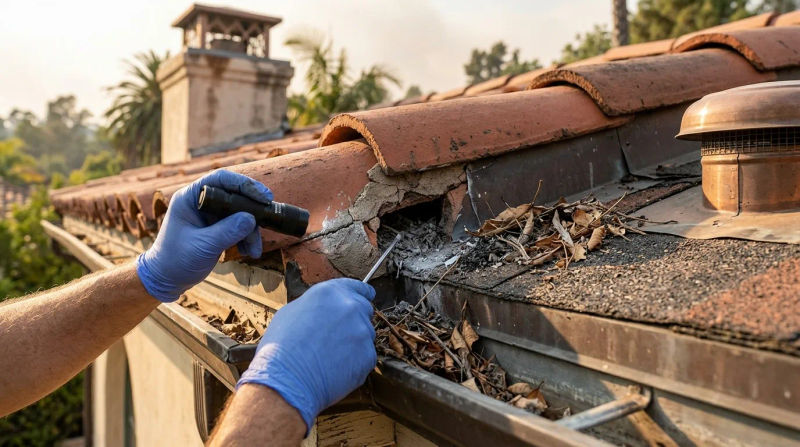
- Debris Accumulation: This is one of the simplest yet most critical Class A roof prep tips. Dry leaves, pine needles, and twigs collecting in your roof valleys, along walls, or in gutters are basically kindling. An ember landing in this dry debris can quickly ignite, creating a fire directly on your roof surface.
- Damaged or Missing Roof Materials: A single cracked tile, a lifted piece of flashing, or a missing asphalt shingle is an open door for embers. These small points of failure compromise the integrity of the entire roof deck, giving embers a place to land on the combustible underlayment beneath.
- Unprotected Roof Penetrations: Your roof has numerous vents for plumbing, kitchen exhaust, and attic fans. Like ridge vents, these penetrations must be properly screened. Our crews often find that plastic vents have degraded from sun exposure or that wire mesh has been damaged, creating openings that are easily breached by embers.
- Outdated Roofing Materials: Is your roof rated Class A? A Class A fire rating means the roofing material (like concrete tile, metal, or modern asphalt shingles) is effective against severe fire exposure. Older homes may have wood shake or other combustible materials that offer little to no protection. Confirming you have a Class A assembly is a foundational step.
- Voids Under Curved Tiles: The classic Spanish or Roman barrel tiles common in Southern California create a beautiful aesthetic, but they also create a challenge. The curved shape leaves a v-shaped void at the eave line. Without proper bird stops or tile blocking, these tunnels become wind-driven conduits for embers.
What Causes These Vulnerabilities?
Understanding why these problems exist can help you appreciate the importance of addressing them. Most roof vulnerabilities aren't due to a single event but are a combination of design, environment, and age.
First, many homes in our area were built before the science of wildfire ember intrusion was fully understood. The primary focus of roofing has always been waterproofing, not fireproofing the small gaps. Construction methods that were standard for decades are now known to be significant fire hazards. The late-summer Santa Ana winds are a powerful force, creating positive pressure that literally forces embers into any crevice it can find. Your roof isn't just a passive surface; it's an aerodynamic structure interacting with extreme wind conditions.
Second, all roofing materials degrade over time. Sealants dry out and crack. Metal flashing can lift and bend. Tiles can shift or break from impact or foot traffic. Constant exposure to intense sun, temperature swings, and seasonal rain slowly wears down your roof's defenses, creating the very gaps that embers exploit. An inspection after a winter storm season is just as important as one before fire season.
Finally, deferred maintenance is a huge contributor. A small problem, like a gutter clogged with leaves or a single cracked tile, might seem insignificant. But in a wildfire event, that one small oversight can be the failure point that leads to catastrophe. A proactive approach is always less costly than a reactive one.
When to Call a Professional
Some fire-safe maintenance is well within a homeowner's ability. You can and should perform visual inspections from the ground with a pair of binoculars to look for obvious issues like debris buildup or broken tiles. If you are comfortable, experienced, and have the proper safety equipment, cleaning your gutters is an excellent DIY task.
However, a thorough inspection requires getting on the roof, which we never recommend for homeowners. The risk of a fall is significant, and you can easily cause more damage by walking on tiles improperly. This is where you need an experienced professional.
You should call for a professional inspection if:
- You notice any broken, slipping, or missing roof tiles or shingles.
- Your roof is more than 15 years old and has not been professionally evaluated for fire-readiness.
- You want to install Beverly Hills roof ember screening on your vents. This requires the right materials and techniques to be effective without compromising ventilation.
- You are unsure of your roof's fire rating or the condition of the underlayment.
- Your home has a complex roofline with many valleys, dormers, or different levels, which create more potential weak points.
Our trained technicians use a standardized workflow and a comprehensive wildfire ember intrusion checklist to ensure every aspect of the roof is evaluated, from the eaves and vents to the flashing and field material. This systematic process guarantees that no vulnerability is overlooked.
Conclusion
Preparing your home for wildfire season is an active process, and your roof is the most important place to focus your efforts. The primary threat isn't a wall of flames, but a storm of tiny embers seeking out the smallest weakness. By walking through the seven checkpoints - from your eaves and vents to the surface of your roof - you can gain a clear understanding of your home's readiness.
Taking proactive steps now, before the Santa Ana winds arrive, is one of the most powerful things you can do to protect your property and gain peace of mind. A well-maintained roof without debris, with all gaps properly sealed, and made of Class A materials is your best defense. Don't wait for an evacuation warning to wonder if your home is prepared.
If you notice any of these signs, contact a local roofing professional for an inspection.